
An official Olympic feature turned the Team USA women’s flag football story into something bigger than a roster note: a look at the players who are becoming visible role models before flag football reaches the Olympic stage at LA28.
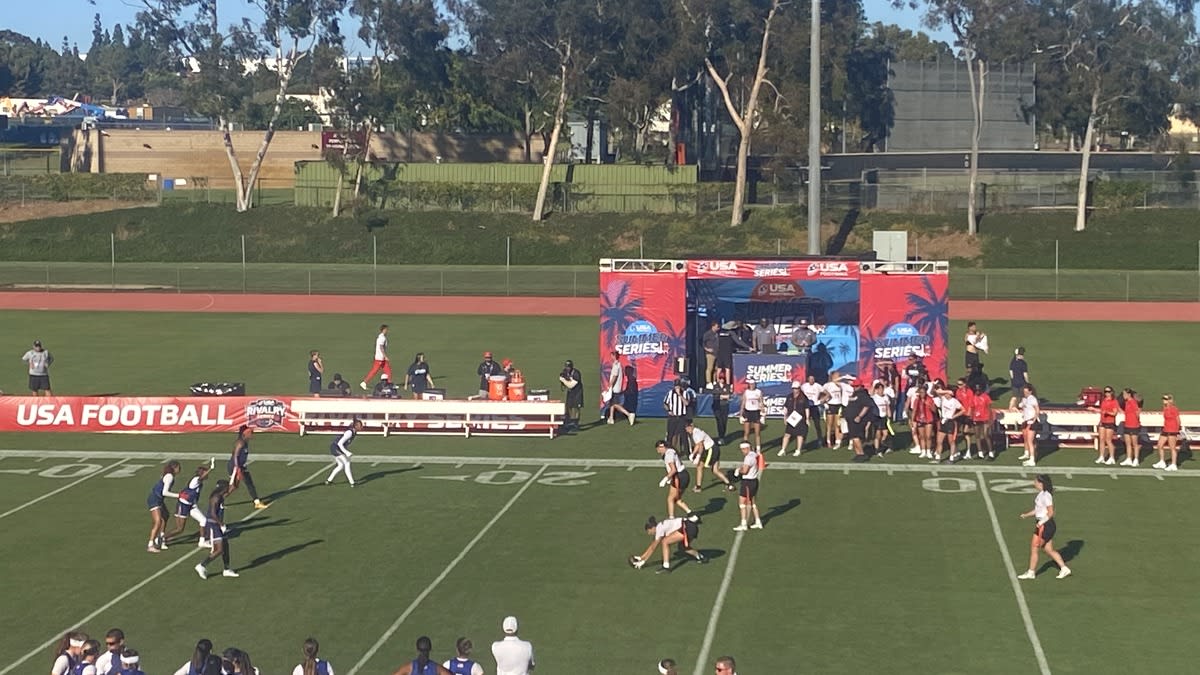
The story focuses on three U.S. women’s national team players who were part of the Summer Series Rivalry game against Canada in Carson: veteran defender Deliah Autry-Jones, Los Angeles-connected playmaker Madison Fulford, and former professional basketball player Loryn Goodwin.
At a Glance
- Story: An official Olympic feature profiled Team USA women’s flag football players Deliah Autry-Jones, Madison Fulford and Loryn Goodwin.
- Event Context: The feature followed Team USA’s Summer Series Rivalry game against Canada in Carson, California, on June 19.
- Olympic Context: Flag football will make its Olympic debut at the Los Angeles 2028 Games.
- College Pathway: The article noted that more than 100 colleges and universities are expected to sponsor women’s flag football this academic year.
- Why It Matters: The players are not only chasing Team USA roster spots; they are becoming the examples younger girls can now see.
The Players Carrying the Story
Autry-Jones gives the story its historical weight. The feature describes her as a six-year national-team veteran, and USA Football lists her as a linebacker/defensive back from Tampa, Florida. She has already represented the United States at multiple IFAF Flag Football World Championships, helping collect three gold medals along the way.
Autry-Jones put the pathway plainly:
“I’m excited that kids have hope.”
That line captures why this moment matters. Autry-Jones began playing organized flag football when the women’s pathway was much thinner. Now the path can include girls high school flag football, college programs, national-team opportunities and eventually the Olympics.
Fulford brings a different kind of visibility. USA Football lists her as a wide receiver/defensive back from Los Angeles, and the article notes that she has spent four years with the U.S. national team. For Southern California families, her presence matters because LA28 will not be an abstract Olympic idea. It will be a local stage, with players tied to the region helping younger athletes imagine where the sport can lead.
Fulford captured the generational shift in one sentence:
“These kids are going to be better than I ever was.”
Goodwin shows another route into elite flag football. A former WNBA player who was drafted by the Dallas Wings in 2018 and spent time with the Los Angeles Sparks, she came to flag football after her basketball career was interrupted by injury. The feature frames her as a high-level athlete who had to start over in a new sport, learn its speed and spacing, and earn her way into the national-team picture.
Why It Matters for Girls Flag Football
The most important part of the story is not just that Team USA has stars. It is that those stars are now visible to young players while the sport is exploding around them.
Girls flag football is growing at the youth, high school and college levels, and the NCAA is moving toward championship status across Divisions I, II and III. The article noted that more than 100 colleges and universities are expected to sponsor women’s flag football as a varsity sport this academic year, with a national title game possible as soon as spring 2028.
That timeline lines up directly with LA28. For a 10-year-old or 14-year-old watching Team USA now, the path can feel real in a way it did not for previous generations. There are camps, college programs, national-team trials, international competitions and a home-country Olympic debut coming to Los Angeles.
For SoCal families, that is the point. The Summer Series in Carson was not only a showcase for current Team USA players. It was a preview of what Southern California could become for the sport: a place where girls can watch the best players in the country up close and then go back to their own leagues, high schools and club teams with a clearer picture of what is possible.
What to Watch Next
The next major question is how Team USA’s women’s roster continues to evolve before LA28. USA Football’s national-team pathway is becoming more competitive, and more athletes from other sports will likely test whether their speed, field vision and competitive background translate to flag football.
At the same time, the college game may become one of the most important development engines. If more than 100 schools sponsor the sport and the NCAA championship pathway continues moving forward, the next wave of national-team candidates may arrive with far more organized flag football experience than today’s pioneers had.
For now, Autry-Jones, Fulford and Goodwin are helping bridge those eras. They are competing for Team USA now, but they are also giving the next generation something the sport did not always have: names, faces and stories to follow.